The tragic death of a young dog shortly after receiving routine vaccinations has sparked an animated exchange of opinions on an agility mailing list. I've been doing some reading ...
The Vaccine Controversy rages on two fronts. The first point to consider is the safety issue. Vaccines can be harmful. We vaccinate because the advantages outweigh the risks. Just ask anyone who has seen a beloved pet die of parvo or distemper. But there are risks associated with vaccinations. For instance some dogs, after being vaccinated with modified live canine distemper vaccine can develop seizures, a lack of coordination and other neurological dysfunctions caused from a rare condition called postvaccinal canine distemper virus encephalitis. Another problem noted with genetically susceptible animals is that it is possible for vaccinations to trigger various autoimmune diseases.
Another source of controversy is the recommended frequency of vaccinations. Although yearly boosters are recommended by most vets, for many diseases the yearly booster really is not obligatory. However, a yearly checkup is necessary for the same reasons you would have one yourself. For the low-risk pet, once the initial puppy series is completed, a booster at one year and another at three years should suffice until your dog's senior years. Unfortunately, no duration of efficacy studies are available yet because minimum duration studies were not required for vaccine licensure until recently. This means there really are no data that tell us how long the immunity lasts in a vaccinated animal, but animal vaccines should compare favorably with the duration of human vaccines. On the other hand, no data supports yearly vaccinations either.
The AVMA vaccine guidelines for dogs and cats released in November 2002 by the AVMA Council on Biologic and Therapeutic Agents recommend tailoring vaccine programs. The "COBTA Report on Cat and Dog Vaccines" concluded that inadequate data exist to scientifically determine a single, one-size-fits-all protocol for vaccination or revaccination of dogs and cats. It said that variations among patients, their lifestyles, and related disease risks, and between individual vaccine products available, necessitate a customized approach to vaccination recommendations. COBTA concluded that evidence shows that some vaccines provide immunity beyond one year. While annual vaccinations have been highly successful in curbing disease, the one-year revaccination frequency recommendation found on many vaccine labels is based on historical precedent, not scientific data. Even in cases where scientific data were submitted to qualify a label claim, the data generated generally represent a minimum duration of immunity and don't resolve the question about average or maximum duration of immunity.
The incentive for reducing vaccination is that various reports show serious immune system suppression in significant numbers of pet animals and humans resulting from routine annual or regular vaccination.
Vaccines can be separated into 'core' and 'non-core'. Some vaccines have had a profound effect by reducing, or eliminating, diseases characterized by moderate to high morbidity and/or mortality. However, other vaccines have had little or no recognized beneficial effect because they were designed to prevent infections that cause little or no morbidity and/or mortality. Some vaccines are so new that the potential benefits they provide are not known e.g., Giardia, Leptospira (L.) grippotyphosa and L. pomona.
A vaccine titer is a blood test that measures the antibody level a dog is carrying against a certain virus. There is a great deal of debate regarding whether or not a certain level of antibody can be considered tantamount to protection. Many veterinarians do not feel it is useful to run titers until this issue is resolved (ie there is more to protection than an antibody level; there is an entire immune system involved and there is no simple way to assess the entire immune system). Other veterinarians find it cost ineffective to recommend titers prior to vaccination (it costs a great deal more to run the titer than to simply give the vaccination. If the titer is adequate, the worst possible outcome is that the vaccine will be ineffective.) Other veterinarians question whether or not it is harmless to annually give vaccinations when there is already adequate immunity present.
March 30, 2005


March 29, 2005


March 27, 2005
How Do You Score as a Puppy Picker?
When Gary Wilkes wrotes this article for a major dog magazine, he was criticised for supporting back yard breeders, but as he says "the bottom line is that good dogs are where you find them and, as I have already said, any source of dogs is a crap shoot."
He says that selecting a puppy is the equivalent of adding a member to your family. The new addition will need to adapt to the dynamics of your existing family members, an environment that is probably devoid of litter mates, parents and possibly even its own species. While a few people use complex temperament tests to make their selection, the majority of dog owners still use emotional criteria to select a pup, or abdicate their power of choice and let the puppy pick them. Using some simple guidelines to help make your decision may allow you to find the puppy that appeals to your senses and your good sense.
Also check out his articles on clicker training originally published in Front & Finish Magazine.
He says that selecting a puppy is the equivalent of adding a member to your family. The new addition will need to adapt to the dynamics of your existing family members, an environment that is probably devoid of litter mates, parents and possibly even its own species. While a few people use complex temperament tests to make their selection, the majority of dog owners still use emotional criteria to select a pup, or abdicate their power of choice and let the puppy pick them. Using some simple guidelines to help make your decision may allow you to find the puppy that appeals to your senses and your good sense.
Also check out his articles on clicker training originally published in Front & Finish Magazine.
March 18, 2005
Rescue
Diesel was my first pedigree puppy, and although I'm getting another dog from a breeder I do support canine rescue and know that there are wonderful dogs available through rescue.
Jon Katz in The New Work of Dogs talks about an apparent need some people have to feel that they have 'rescued' a dog from a life of abuse, and you will hear people say "He's a rescue dog" with an eyebrow raise that suggests a past blackened by horrors too terrific to mention. Of course there are far too many animals that have been abused, a moment in front of tv news tells you that. But for the most part the dogs available through animal rescue have just become inconvenient - a new house or baby, or a need for some training, or they wandered away. Not all rescue animals have baggage to be overcome, or problems to be worked through. Indeed most that are re-homed do not.
PetRescue are a new, not for profit, organisation dedicated to rehoming shelter animals across Australia. They act as an umbrella site for breed or location specific rescue across Australia.
Australian Cattle Dog Rescue is devoted to the Cattle Dogs (and Stumpy Tailed Cattle Dogs) in Australia that are in need of loving homes.
Jon Katz in The New Work of Dogs talks about an apparent need some people have to feel that they have 'rescued' a dog from a life of abuse, and you will hear people say "He's a rescue dog" with an eyebrow raise that suggests a past blackened by horrors too terrific to mention. Of course there are far too many animals that have been abused, a moment in front of tv news tells you that. But for the most part the dogs available through animal rescue have just become inconvenient - a new house or baby, or a need for some training, or they wandered away. Not all rescue animals have baggage to be overcome, or problems to be worked through. Indeed most that are re-homed do not.
PetRescue are a new, not for profit, organisation dedicated to rehoming shelter animals across Australia. They act as an umbrella site for breed or location specific rescue across Australia.
Australian Cattle Dog Rescue is devoted to the Cattle Dogs (and Stumpy Tailed Cattle Dogs) in Australia that are in need of loving homes.
March 16, 2005
Canine Gestation
I know nothing about pregnancy in dogs, except that nine weeks sounds a lot better than nine months, but there is some good information available. The Canine Pregnancy Calendar allows you to enter the date of first mating, and gives you the milestones along the way.
The VCA's Guidelines for Responsible Breeders includes information on conception and pregnancy. What to Expect When You Are Expecting Puppies, says "Dogs began having puppies long before humans came into their lives. So there’s no vital need for intense, day-to-day management of your pregnant dog. It’s much more important for owners to understand what’s normal during their dog’s pregnancy and to intervene when there are signs of trouble."
The VCA's Guidelines for Responsible Breeders includes information on conception and pregnancy. What to Expect When You Are Expecting Puppies, says "Dogs began having puppies long before humans came into their lives. So there’s no vital need for intense, day-to-day management of your pregnant dog. It’s much more important for owners to understand what’s normal during their dog’s pregnancy and to intervene when there are signs of trouble."
March 15, 2005

Ikenheel
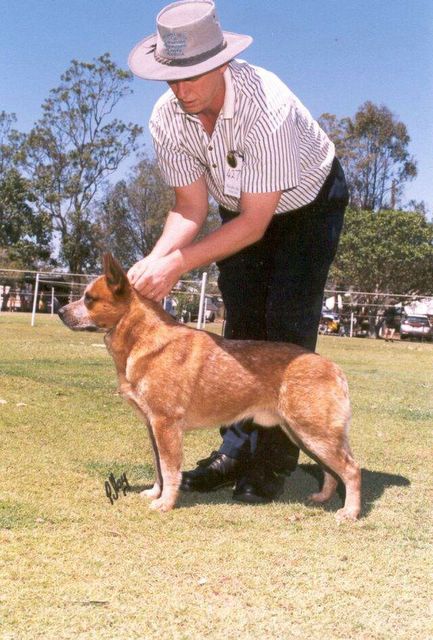
One of the problems I have in choosing a puppy is that it is important to me to find a breeder who is serious enough about breeding to have assessed the sire and dam in terms of their health, temperament, phenotype and genotype; and yet is a small enough venture that the puppies are home-raised with individual, personal attention. There are not too many around that do both.
One who meets the criteria is Ikenheel. Deb has announced on the website that Galwarri Red Rose ADX CD ET HIT JDM has been successfully mated to Grand Ch. Bangeeri Aussie Alchemist.
Also, a distinct advantage of an Ikenheel puppy is that Deb and Murray will ensure that its agility training is well advanced by eight weeks of age, so hopefully it will be able to teach me a thing or two.
One who meets the criteria is Ikenheel. Deb has announced on the website that Galwarri Red Rose ADX CD ET HIT JDM has been successfully mated to Grand Ch. Bangeeri Aussie Alchemist.
Also, a distinct advantage of an Ikenheel puppy is that Deb and Murray will ensure that its agility training is well advanced by eight weeks of age, so hopefully it will be able to teach me a thing or two.
Breeding Experiments
Bruce Cattanach says "crossbreeding is no longer a recognised option but for the first 50 or so years of this century, crossbreeding to allow the introduction of new or otherwise desirable characters into established breeds was permitted by the Kennel Club". A breeder of Boxers for over 40 years, he was always irritated by the need to dock tails to achieve the desired characteristics. So when faced with potential changes in tail docking legislation, he acquired two boxers with screw tails and bred them but found it was not an hereditary condition - all the puppies had long tails.
Friends asked him to look into the inheritance of a bob-tail condition in Corgis that exists in a few show lines, and he found that the condition bred true, with no associated abnormalities.
He decided that "it would really be fun to try and breed a Boxer with an inherited short tail." The story of his experiment makes interesting reading.
In quite a different experiment the Soviet Union's Institute of Cytology and Genetics tested a hypothesis to look at whether selection of breeding foxes for tameness could bring with it the changes in appearance that were associated with the domestication of dogs.
Friends asked him to look into the inheritance of a bob-tail condition in Corgis that exists in a few show lines, and he found that the condition bred true, with no associated abnormalities.
He decided that "it would really be fun to try and breed a Boxer with an inherited short tail." The story of his experiment makes interesting reading.
In quite a different experiment the Soviet Union's Institute of Cytology and Genetics tested a hypothesis to look at whether selection of breeding foxes for tameness could bring with it the changes in appearance that were associated with the domestication of dogs.
Subscribe to:
Posts (Atom)
