March 09, 2005

Health

A breeder needs to be aware of the hereditary diseases in the breed, and to test for at least the common ones. The Cambridge Veterinary School database on inherited diseases in dogs lists the Australian Cattle Dog as:

  • Hip dysplasia - Lameness in hind legs and gait problems.
  • Progressive Retinal Atrophy - Loss of night vision progressing slowly to total blindness.
  • Sensorineural deafness - Congenital deafness.
  • Elbow dysplasia - Swollen painful elbows and lameness.
  • Lens luxation - Luxation (eversion) of the lens accompanied by glaucoma and pain.
  • Ceroid lipofuscinosis - Progressive loss of night vision followed by neurological deficits and blindness.
  • Polioencephalomyelopathy - Seizures, spastic paresis by 5 to 6 months of age. Vacuolar degeneration cerebellum, brain stem, spinal cord.
  • Portosystemic shunt - Vascular shunt bypassing liver leading to toxic encephalitis.

How are defects inherited? Through the genes. New DNA tests for inherited diseases in the dog are steadily increasing, as our understanding of canine genetics gets more detailed.

The goal of breeding

The goal of breeding must be to produce better dogs – not to produce more dogs. You hear a whole range of reasons for letting Fluffy have a litter from “letting the children witness the miracle of life” to “she’s a lovely dog and my neighbour has a male of the same breed” to “these puppies sell for $800, with a litter of six I could really make some money.” All of these goals are frequently thwarted as the birth becomes a traumatic experience, puppies inherit crippling disorders, and vet bills consume potential profits.

Responsible breeders follow a series of steps to ensure that their knowledge and experience will result in a mating that will produce an exceptional litter of puppies that will go to excellent homes. Before deciding to produce a litter of cute puppies, the potential breeder should assess their dog in terms of:
  • health
  • temperament
  • phenotype
  • genotype

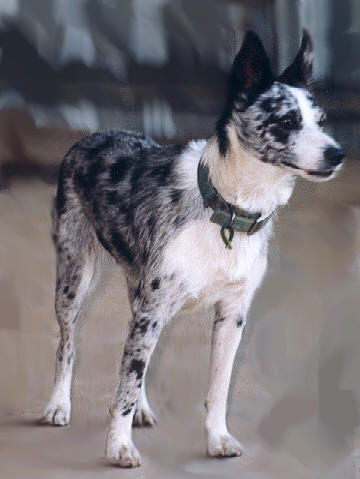
Morrie Oxley's Koolie, Victoria Aus Posted by Hello

March 08, 2005

Koolie

I had an email from Greg C. who reminded me of the Koolie, my only excuse for not having them on my shortlist is that they don't come up on the puppy picker websites.

Another Australian breed, the Koolie was referred to by Robert Kaleski in 1911, saying that at the time there were many varieties of working dogs. One particular one called the Welsh Heeler or Merle was commonly referred to as the German Koolie. The Koolie is one of the oldest breeds of working dogs in Australia, however records were never kept regarding parentage. Reputable breeders are now working to keep accurate records, and to avoid the deaf/blind consequences of the merle gene.

Heide the Koolie

The Koolie has high energy levels and is not happy confined to a suburban backyard. It needs both mental and physical activity to prevent boredom. As with most working breeds it excels at obedience training and is athletic and enthusiastic making it an ideal dog for those owners who choose to participate in flyball or agility. This is not the breed for sedentary owners. Greg says of his nine month old bitch "she does have an off switch, but sometimes I have to remind her that it works."

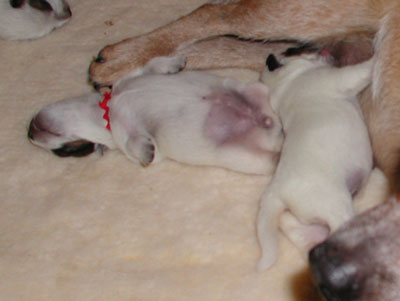
Bess's pups have a nap after lunch. Posted by Hello

Cow Dog

Writing up the various choices made obvious what I really knew from the beginning - I'm going to get another Australian Cattle Dog. I might import buhunds as a retirement project, and I'd like a kelpie at some point. But for now I'm looking for a cattle dog. Probably a girl, hopefully red.

There are some folk wisdoms about the differences between males and females. In Woman's Best Friend Babette Haggery-Brennan says:

"Males will be more likely to be bossy whereas females will be bitchy, hence the name. There is a higher incidence of aggression in males than in females, and if you already have a male, I would recommend a female. However, males do tend to bond more with the lady of the house."

Robert Kaleski who compiled the first breed standard for the Cattle Dog, thought a red cattle dog looked more like a Dingo than a blue, therefore he had a prejudice against the red dogs. This myth has persisted particularly in rural areas where otherwise intelligent people will tell you that the red is more likely to be vicious than the blue.

Occasionally someone will also say that their dog is a cross between a red and a blue. There is no such thing as a red and blue cross puppy, they are different colours of the same breed. There can be both red and blue pups in the one litter.

The cattle dog's colour is a result of its genetic makeup. Cattle dog puppies are born white and develop their adult colour as they mature.

March 07, 2005

Derrett & Garrett & Puzzle

I'm just back from a five day seminar with Greg Derrett and Susan Garrett - Nicola had Puzzle with her. He was nearly nine weeks old, and had been at his new home for just a few days so it was a big occasion for him with lots of new dogs and people.

Puzzle is a Labradoodle. He is a great little dog, alert and confident but in a quiet, self contained way. In his crate he sleeps and/or entertains himself. Outside he confidently explores, happily interacts with people and dogs, and quickly learns his lessons.

Labradoodles have achieved recent popularity, but they have been bred in Australia for thirty years, a result of The Guide Dog Association implementing research and breeding programs in search of an allergy friendly guide dog.

Tegan Park and Rutland Manor are probably the oldest established Labradoodle breeders in Aus, though in the last few years we have seen a proliferation of breeders who offer Spoodles and Groodles and Schnoodles and Cavoodles in response to a demand triggered in part by lifestyle tv shows. One such show placed 'Designer Mongrels' in second place on their top ten dogs list with the ludicrous statement: "They are all fabulous little family dogs, which have fewer veterinary problems than their purebred parents. "

A poorly bred dog is a poorly bred dog, regardless of what breed the parents are. A labradoodle from an uninformed back yard breeder or puppy mill will be no more or less fabulous than a pure bred dog from the same breeder.

Derrett and Garrett? I think Greg is fantastic. He remembered our dogs from a year ago, and had an encouraging word for everyone. Susan's presentations were primarily chalk and talk lectures, and I think she got cross with us for not taking it all in. But her methods are great, and I'll be buying her book as soon as it's released. And I'll be actually practicing the drills in Greg's videos.

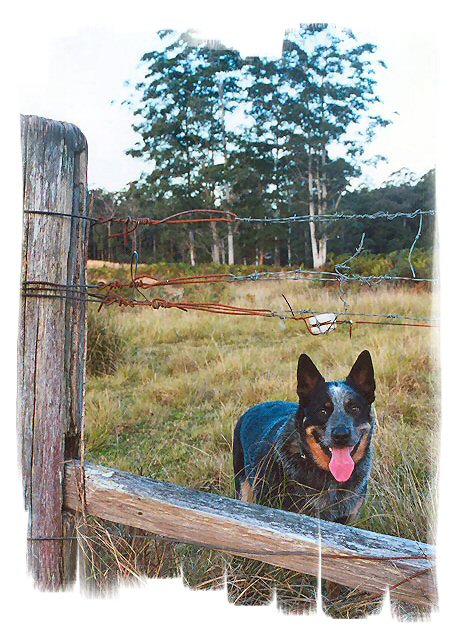
Thommo Posted by Hello

Australian Cattle Dog

Over a lifetime I have had more ACDs than any other breed. I grew up on a cattle station in central Queensland where they were an integral part of daily life. I currently have a six year old male, Thompson.

They seem to be a breed that people don't much like until they have one, and then they love them. There is quite a bit of information available about them, and a number of dedicated websites including Cattledog.com. Their history is often misrepresented, mainly because one of the earliest writers about the breed changed his story later in his career. Noreen Clark's history based on rigorous document research and a sound knowledge of genetics is the only one that provides evidence for claims about the origins of the breed.

Narelle Robertson's guide for judges sets out the standard in pictures and the Nth Qld ACD Newsletter archives has a range of articles on topics from health to training.

ACD breeders near me include:

March 06, 2005

Australian Shepherd

Despite the misleading name, the Australian Shepherd is not Australian at all, but was developed entirely in the U.S. to work as a herding dog on ranches.

A little research has led me to drop it off my short list, though this doesn't mean it won't make someone else a wonderful pet. It is traditionally docked if born with a tail (though this is now unlawful in Australia), and its dew claws removed. It carries the blue merle gene and associated blind/deaf factor. The naturally bob-tailed dogs can have serious spinal defects. Caratacts are a problem, and they are often sensitive to ivermectin.

The concern about the seeming increase in frequency of genetic problems in Aussies has led to the establishment of the Australian Shepherd Health & Genetics Institute .