March 06, 2005


Belgian Shepherd Posted by Hello

Belgian Shepherd

There are four varieties of Belgian Shepherds, differentiated only by the length and colour of their coats, though in the US the varieties are treated as separate breeds.
There is the
  • Groenendael (Long black coat),
  • Tervueren (Long coat, fawn to grey (other than black) with a black overlay and mask),
  • Malinois (Short coat, fawn with black overlay and mask)
  • Laekenois (rough coated fawn - sort of like an Airedale Terrier coat - and there are only said to be 3 of these dogs in Australia to date).

These are intelligent, strong willed dogs and even major fans of the breed acknowledge that they are not a dog for everyone. They can be a difficult dog for a novice owner and it is important to choose your Belgian puppy carefully.


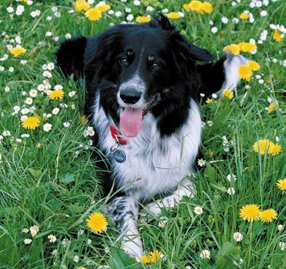
Border Collie Posted by Hello

Border Collie

The border collie is probably the first choice of people who are looking for a 'working dog', whether the work is their traditional farm tasks, or modern dog sports such as obedience and agility. Like other working breeds they need exercise and a mental challenge if they are not to be noisy or destructive. The border also likes it's owner to be on the ball, and will give a swift nip to those who don't get the point fast enough.

Breed clubs are well established around the world, and can provide a wealth of information for the prospective owner. Border collie rescue is also well developed in Australia and elsewhere and is an excellent source of a dog with known characteristics, although browsing the reasons why dogs were surrendered emphasises the need for company, stimulation and secure fences.

Borders can also be nervous dogs, afraid of thunder and lawnmowers; or obsessive, staring at the tap waiting for it to drip, or chasing your shadow.

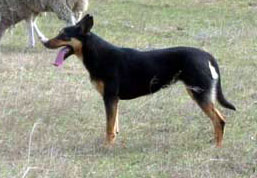
Working Kelpie Posted by Hello

Kelpie

The kelpie is an Australian herding breed. The kelpie was first registered as a breed in Australia in 1902, one of the earliest registered breeds in Australia. It is one of those breeds that has divided into two - show dogs and working dogs, or dogs registered by the Australian National Kennel Council and dogs registered with the Working Kelpie Council of Australia. There are differences in appearances with the show or bench kelpie having a more compact body and a wider range of colours, the main difference is in working ability.

The bench kelpie is slightly less active than the working type, and less successful as a herding dog, though perhaps easier to manage as a family pet in the city. The working kelpie needs daily, extensive excercise of a sort that challenges their intellect while it tests their stamina. Bench kelpies are generally known as kelpies and the others as working kelpies.

The two kelpies I know best, Scoot and Oops, are a great advertisement for the breed.

March 05, 2005


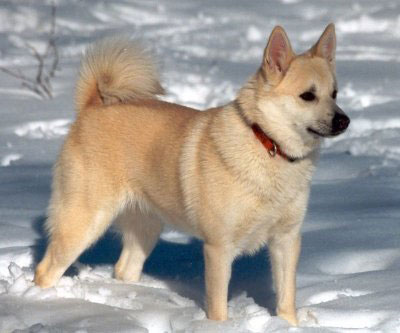
Norwegian Buhund Posted by Hello

Norwegian Buhund

If you want a dog who...

  • Is medium-sized and spitz-like, with a wolfish face, prick ears, thick coat, and curled tail
  • Is sturdy and strong, yet athletic, agile, and light on his feet
  • Is less headstrong and more willing to work with you than other spitzes
  • Is happy-go-lucky, plays vigorously, and likes a lot of outdoor exercise
  • Is polite with strangers, yet with his keen senses and watchful attitude, makes a dependable alarm dog ...


a Norwegian Buhund may be right for you. (Your Purebred Puppy) National Kennel Clubs and Breed Clubs will be able to give you information and breeder contacts - UK Norwegian Buhund Club.

However when I made enquiries with the state body, the Royal NSW Canine Council and the national body, the Australian National Kennel Council, I discovered that no Buhunds had been registered in Australia in the last twenty years. Checking with the Norsk Kennel Klub I was told that a pair had been exported to Australia in the 1970s but had "escaped into the bush". The good people on the Buhund list had heard of a male buhund in New Zealand some years ago, but that didn't help me much.

Importing a Buhund I guess is an option, but Australia's quarantine laws complicate the process as dogs from overseas have to remain in quarantine for at least thirty days. In any case, owning the only Buhunds in Australia I'd feel some obligation to breed and show which doesn't really interest me at the moment.

Clever Dogs

Most of the puppy picker tools are coming up with similar dogs (provided I lie about the size of my backyard). These are mainly the herding breeds with short hair. I'm not crazy about dogs (or men) with wet beards and food encrusted moustaches. So my first list is:
  • Australian Cattle Dog
  • Australian Shepherd
  • Belgian Shepherd Dog
  • Border Collie
  • Cardigan Welsh Corgi
  • German Shepherd Dog
  • Kelpie
  • Norwegian Buhund
  • Papillon
  • Poodle
  • Shetland Sheepdog

I'd rule out the papillon, sheltie and corgi because they are small, and I'd like a dog that could provide at least symbolic protection, and the poodle because I don't want groomers to be an integral part of my life, and the german shepherd for no real reason - just don't like a lot of them I've met.

March 04, 2005

Choosing a breed - read a book.

There are so many things to consider when deciding on which breed to get, and which breeder to choose that it is not suprising that there are a number of books written on the topic.

Your Purebred Puppy: A Buyer's Guide by Michele Welton has an excellent section of questions to ask a breeder before looking there for a puppy, however the information on particular breeds can be a bit general. Under cautions when buying, for example, the same caution is given for many breeds "Don't choose a scrappy, timid or frail puppy" so you may want to read this in conjunction with a more comprehensive dog breed encyclopedia.

Complete Idiot's Guide to Getting and Owning a Dog and Puppies for Dummies are from the two series of information books and are good general reference books that are widely available.

Paws to Consider by Brian Kilcommons & Sarah Wilson is a refreshingly candid guide. Topics covered include:
  • Genetic health problems for all breeds: which popular breeds go bald, which big dogs get orthopedic problems, and why others get cancer.
  • Daily exercise requirements: a once-a-day jog satisfies a Borzoi (yes, it makes a great city dog), while a Labrador needs hours of fetching and playing.
  • Classic temperaments for nearly one hundred breeds: a Golden Retriever will desperately want to please you, but a Beagle will be deaf to your call if he finds a rabbit trail.
  • Lifestyle matches: for instance, a French Bulldog will travel with you anywhere and a Keeshond is perfect for active young families.
  • The potential problem dogs: Jack Russell Terriers, Dalmations, and certain other breeds that can give you more than you bargain for.

You might find their criticisms of your favourite breed a bit negative, but at least you are prepared for the traits your puppy exhibits down the track.